

|
|
| |||||||
|
Back to Background
Information | ||||||||
|
| ||||||||
|

| ||||||||


Introduction to Fibre-Optic Cables
Indoor cable includes: simplex; duplex; multifibre; heavy-, light-, plenum-duty and riser; and breakout.
Outdoor cable includes: overhead, direct- and indirect-burial; and submarine. This cable is able to withstand harsher environmental conditions than indoor.
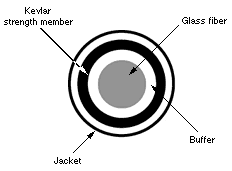
Simplex cable contains a single fibre that carries signals from transmitter to receiver in one or two directions.
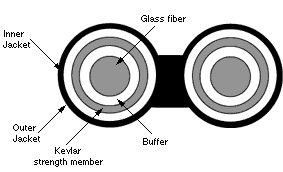
Duplex cable contains two fibres. With duplex operation is possible with two simplex cables, duplex cable is preferred for ease (less chance of the two channels beocming confused), convenience, and appearance.
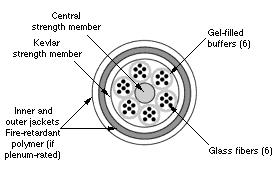
Multifibre cable contains more than two fibres. They allow signals to be distributed throughout a building. Fibres are usually used in pairs, with each fibre carrying signals in opposite directions.
Heavy-or Light-Duty are terms that refer to the ruggedness of the cable.
Aerial or overhead cable is strung between buildings for telephone poles. Direct Burial cable is placed directly in a trench dug in the ground and covered. Indirect Burial is similar, but the cable is inside a duct or conduit.
Plenum-Duty cable meets the National Electrical Code (Article 770) requiring that cable being run through air spaces between walls, under floors and above ceilings be enclosed in fireproof conduits or be insultated and jacketed with low-smoke and fire-retardant materials.
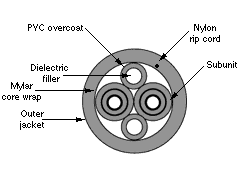
Breakout cables have several individual simplex cables inside an outer jacket. They include a ripcord which permits the "break out" of several fibres from the bundle at any location for routing elsewhere. Riser cable runs vertically between floors and is engineered in such a way as to prevent fire from spreading between floors.
Tactical-Grade is a breakout cable with crush resistant properties.
|
Multifibre Cable (six shown) |
Simplex Cable |
|
|
|
|
| |
|
Duplex Cable |
Breakout Cable |
|
|
|

|
To visit
Fiber Options |
BACK TO
TOP Back to Background Information | Back to Tutorial/Product Line Information | Browse Product Index | Glossary of Terms Contact Us | Company Profile | Access Control
Systems | Twisted Pair | Coax Splitters | Enquiry Form |

This site was designed and produced by Internet
PageMakers