

|
|
| ||||||||
|
Back to Background
Information | |||||||||
|
| |||||||||
|

| |||||||||


Introduction to Fibre Multimode vs. Single-Mode
Point-to-point fibre-optic transmissions systems are configured with fibre-optic cable. Cable can be comprised of one strand of fibre (sometimes called simplex) or two strands (called duplex). Standard fibre-optic cables are available with up to 48 strands of fibre.
Whatever the number, when optical fibre (core, cladding, and coating) has been combined with a buffer, a strength member for support, and jacketed, it is considered to be fibre-optic cable.
Refer to Figure 1 above.
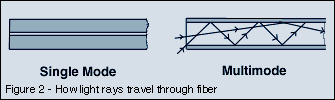
FibreTwo general types of fibre have emerged to meet user requirements: single-mode and multimode. In optical terminology, "mode" is the word used to describe the ray of light that travels through the fibre.
Refer to Figure 2 below.
In single-mode fibre, as the name would suggest, a single light ray, or mode, is transmitted along the core of the fibre.
In Multimode fibre the name does not refer to the number of strands of fibre in the fibre-optic cable, but rather to the multiple modes, or rays of light, that are transmitted down the core of multimode fibre.
Multimode fibre is further defined as step-index or graded index.
Step-index multimode derives its name from sharp step-like differences in the refractive index of the core and cladding.
Unlike step-index fibre, graded index cores contain many layers of glass, each with a lower index of refraction. The effect of this grading technique is that the light rays that are travelling through the glass core of the fibre all arrive at the receiving photodiode at the same time.
Today, graded-index is the accepted standard for multimode fibre.
Fibre ComparisonAs a generalization, better optical fibre performance means higher bandwidth, higher information-carrying capacity, and lower loss.
Based, on these generalizations, performance (from lowest to highest) is:
- 1 Plastic
- 2 PCS
- 3 Step-index multimode
- 4 Graded-index multimode
- 5 Single mode
- 2 PCS

|
To visit
Fiber Options |
BACK TO
TOP Back to Background Information | Back to Tutorial/Product Line Information | Browse Product Index | Glossary of Terms Contact Us | Company Profile | Access Control
Systems | Twisted Pair | Coax Splitters | Enquiry Form |

This site was designed and produced by Internet
PageMakers